Friday, 15 August 2014

Turkish Delight: Love At Second Sight

Istanbul: First Look

The Flight Route
My First Meal in Istanbul, with the Volunteers

The Milion Stone

Distances of different world capitals from Milion Stone


Me, Hamid Jalilee, Fatma, Dougkan, Ahmet, Beyzanur

Sea of Marmara


Shake Shack!

'Hala' in Isteklal


(I traveled to Turkey for vacation during first half of July,2014. Following is an account of my experiences en route to Istanbul and onwards. This is the second installment of the series, focusing on the departure from Lahore Airport and First day in Istanbul. I hope you enjoy it.)

Wednesday, July 2nd, 2014

I reached Lahore Airport well in time before the flight. I had never been too late to catch a flight or a bus because of my fathers’ insistence to be extra-careful in these matters. My flight was supposed to fly at 5.30 am and I had arrived at the airport at 2:00 am, with a couple hours of sleep. I am not a nigh-person by any stretch of imagination and do not like anything more than a good nights’ sleep, so this was one of those nights when I sacrificed my sleep for “a greater cause” (:P). I took a seat at the waiting area, alongside two Turkish men. One of my high-school friends was studying in Ankara on a scholarship and he had sent me a small guide-book outlining basic phrases in Türkçe. Based on my previous experience in Turkey, I had decided to learn the basics of language. I had tried to memorize some of the important phrases given in that book, and had relied on Google Translate for pronunciation.

We waited till 3:00 am for the check-in counter to start functioning. There were two flights (one of Emirates, the other of Etihad) ready to leave before us and their passengers had spent hours while checking-in. As soon as one of the flashboards showed the number of our flight, the two Turkish men leapt towards the counter and positioned themselves at the front of the line. I walked behind them and found a place in the same line. There was an additional queue for business class passengers. The clock kept ticking while we stood there. 15 minutes, 25 minutes, 30 minutes, 45 minutes. The line stood still; there was no one at the check-in counter to help us! A tall Turkish guy in the business class queue got impatient. Initially, he asked politely for the “manager” of the area. There was no reply. We were informed that it was time for ‘Suhoor’ and thus the staff were busy in that. Later, we got news that staff was busy in Fajr Prayers. This was too much to take for the tall Turkish guy, who started shouting at the manager and anyone who cared to listen. He pointed to the Turkish guys standing in my line that no Pakistani was protesting, and everyone was just standing there, in no hurry.   

After 45 minutes of standing in the queue, the staff miraculously appeared. Another issue surfaced this time. Apparently, a tax had been imposed in the latest budget and everyone who got their tickets after 30th June, 2014 had to pay an extra Rs.1200 ($12) at the counter! This was unprecedented and most passengers balked at this idiotic gesture. Some people did not have enough cash on them, some were only carrying US Dollars and the check-in counter staff did not have any currency other than Pakistani Rupees. Even Credit/Debit Card facility was not available and they only accepted cash. It caused a minor kerfuffle but eventually, the line started moving. On my turn, I asked the check-in guy to assign me a window-seat, which he did.  After almost 70 minutes standing in that line, I was able to get past the Check-in and in the Departure Lounge. It was there that I first used my newly-acquired Türkçe skills and asked one of the two Turkish men that I had seen, if he knew English (İngilizce biliyor musun). To which he replied, “Yes”. I told him about the gate number where we were supposed to gather, as he was sitting at the wrong gate previously.


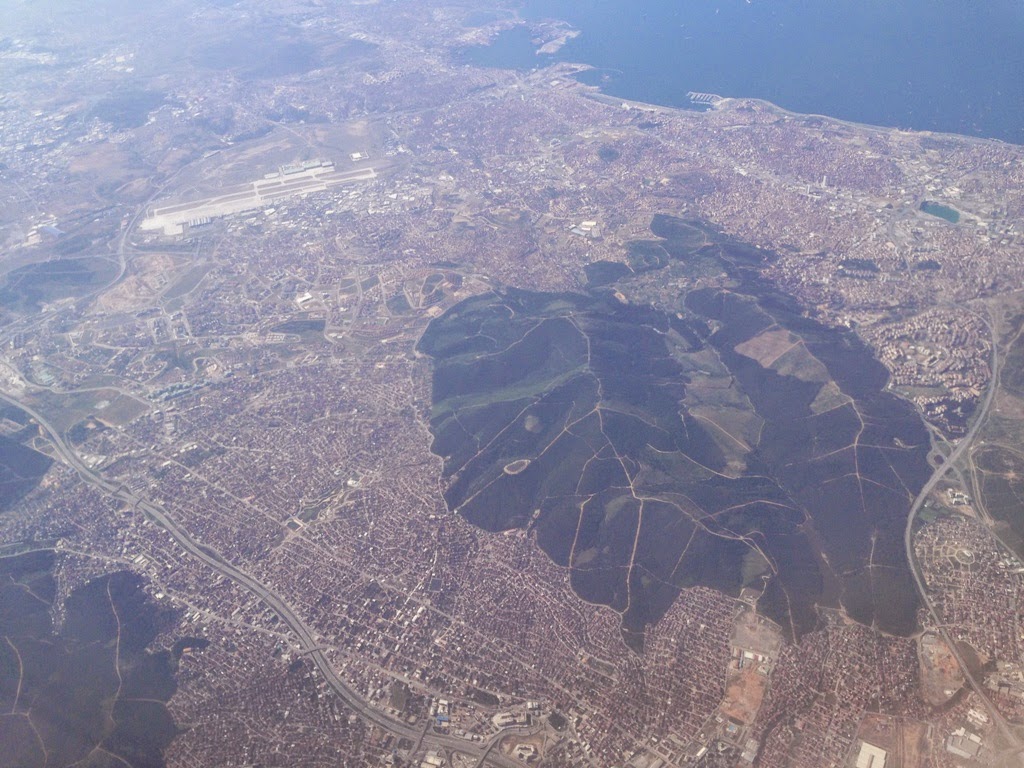
The Flight left Lahore at 5:35 am and I sat comfortably in my window seat, gazing at the beautiful sunrise over Lahore. I slept for sometime and woke up when our plane had crossed Afghanistan. We crossed Baku and entered Turkey soon afterwards. We could not land at Istanbul airport at once and had to wait for a few minutes due to some technical issues. Meanwhile, the pilot gave us an excellent overview of Istanbul, the vastness of which amazed me(I later discovered that Istanbul’s total surface area is FOUR times as big as that of New York City!). The last time I had landed at Ataturk Havalimani(Airport), there were long lines at the Passport control points, but this time was different. There were hardly any people and it took me less than five minutes to get my passport stamped till the baggage collection section.


More than half of the passengers on our plane were in Istanbul for Transit and were moving on to further destinations, because of which the rest of us had to wait for another 30 minutes till our luggage arrived. During that period, I got to talking with a fellow Pakistani who was going to Italy after spending 3 days in Istanbul. It was his first time in Turkey so I gave him some pointers about the situation. As soon as my bag arrived, I took it and ran towards the exit doors. My first task was to get some Turkish Liras and then to get an Avea SIM card. I got the US Dollars changed and got a new SIM. I discovered at the kiosk that a mobile phone in which a Turkish SIM has been previously used, can’t be used again in Turkey. It was weird to know, but fortunately I had a spare phone so I got the SIM card for that. I asked the salesperson internet package, which he informed me about. He also instructed me to turn the phone to “Airplane Mode” and only use the phone after two hours.

I moved out of the airport and took a Taksi to Sultanahmet. Using Tripadvisor.com, I had booked myself in for five nights at Saba Hotel near Sultanahmet/Blue Mosque. I had spent two days in that area last year so I knew the place a bit. The weather was nicer than in Lahore and I kept the window open throughout the ride. I told the driver in Türkçe about the hotel and showed him the email from the hotel that I had printed out. He called someone and asked them about exact location of the place. As we got near Sultanahmet, he informed me that due to traffic issues, he won’t be able to drop me in front on the Otel but near it. I was okay with it as I don’t mind walking. As it turned out, he had dropped me off on the backside of Sultanahmet and I had to drag my bag through the cobblestoned streets till I reached the mosque. I was relieved to see it because I knew my hotel would be somewhere nearby. I walked slowly in the hippodrome area and tried to see any hotels around the area. I reached Gate C of the mosque and was standing aimlessly when three teenagers wearing blue shirts approached me. They asked if I needed any help, in English. I was relieved to hear someone speaking English and told them that I definitively required help and that I was Lost! I showed them the email from the Hotel, which had mentioned their address and a small-ish Google map was also given.  

Despite the instructions given in the email and Google search by those teenagers, we were not able to figure out my destination. A slightly older girl in a red shirt came over and asked us about the issue. She saw the email and after some discussion with the teenagers, was unable to locate the place either. She said that she will help me find it and starting walking towards Hagia Sophia. One of the volunteers asked if I would like to have lunch with them. I accepted their offer delightedly, and walked with them to their office on the other side of the Mosque. I discovered that the teenagers were volunteers, working for Fatih Municipality(which contained numerous tourist attractions), guiding tourists in English, without charging anything. They were aged 15-25 and most of them were either in high schools or in initial years of university. During my last visit, I had not seen the volunteers as their tenure ended in September and I had visited in the second week of September. I enjoyed lunch at the office, while talking to many volunteers. Most of them had never met a Pakistani before, so it was my duty to leave a good impression upon them. After we finished the meal, one of the volunteers(Doğukan) escorted me to the area behind the mosque. He explained the history of the Hippodrome and the cages where Lions were kept. During our walk, we asked someone for directions to Saba Hotel and were finally guided in the right direction.  

We crossed the Marmara University Presidency and I found the sign of my hotel in the adjoining street. I stopped Doğukan in his tracks, asked him to get back to where he was deputed and promised to come back and hang out with him as soon as I checked in to the hotel. The lady at the hotel reception was very nice and friendly and she guided me to my room. When I paid the bill using a Credit card, it dawned upon me that I had accidentally booked a really expensive hotel. The friendly lady informed me that Wi-Fi service was only available in the Lobby, which was a big let-down.


After Checking into my room, placing my luggage and changing my shirt, I headed to the Hippodrome where I joined Doğukan and Fatma Betül. They took me on a little tour of the Hippodrome, starting from German Fountain to the Egyptian Obelisk and Roman Obelisk and then to the Milion Stone. We later sat down on one of the many benches placed in the Hippodrome and talked about history and each other. During that time, I restarted my mobile and it started working. It was a relief to finally have 3G service. After almost an hour of this chit-chat, we were joined by a guy sitting on a bench nearby. He was Mr. Hamid Jalilee from Iran, a businessman learning Türkçe in Istabul. We talked about common words in Persian, Türkçe and Urdu(Pakistan’s national language, which is a mix of Arabic, Persian and Sanskrit). We also taunted the Turkish teenagers about the poorly cooked rice, found in Turkey. During our chat, we were joined by Ahmet Kaya and Beyzanur. We talked and talked and talked for almost three hours, and I left the area around 6 p.m., having sat there since 1 p.m. I learnt plenty of words and names that day, which helped me during the rest of my stay.

It was tiring(as I hadn't had much sleep in the preceding 24-30 hours) but it was sooper fun. I left for my hotel, which was hardly five minutes away from the Hippodrome and took some rest. One of my Pakistani friends is studying in Australia. One of her classmates was doing an internship in Istanbul and was staying in Sultanahmet. I caught up with her after some rest at the Hotel. We walked towards the Marine Drive, and sat alongside the Sea of Marmara. She had graduated with a degree in Psychology and was pursuing a Masters Degree in “Role of Gender in Development”, a subject close to my heart. We talked and walked alongside Keneddy Cadessi(Road) towards Galata Bridge and took the Tunel to Isteklal Cadessi. I was terribly hungry so I got some fries and a shake from Shake Shack which lies right next to the Tunel station. Last time, I had walked across Isteklal twice without visiting Shake Shack even once, and upon my return had heard rave reviews about its burgers and fries. My new friend gave me an Istanbulkart which was a blessing. We walked across Isteklal, enjoying the live music and at one place, a group dance(I was later told that it was called ‘Hala’, a traditional Anatolian Dance). We took the Funicular from Taksim to Kabatas and from there we took the tram to Sultanahmet. I reached my Hotel around 11.30 pm and was really exhausted so slept immediately. It was a wonderful first day in Istanbul.


(To be continued)

Thursday, 14 August 2014

Turkish Delight: Preface

Our Turkish Airline Plane crossing Afghanistan

Istanbul: First Look
(I traveled to Turkey for vacation during first half of July,2014. Following is an account of my experiences en route to Istanbul and onwards. This is the first installment of the series, focusing on the planing and visa phase of the journey. I hope you enjoy it.)


Life is a sequence of births and deaths. Moments are born and moments die. For new experiences to come to light, old ones need to wither away. 

Elif Shafak


Preface

I was not supposed to be in Istanbul in the summer of July, 2014. There was no such plan beforehand. I wanted to travel abroad and my eyes were set on Europe as the possible destination. My sister lives in Germany and I wanted to visit her and my nephew. I filled the application form for Schengen visa and obtained requisite documents (Passport valid for at least three months after arrival, health insurance, hotel booking, bank statement, air ticket, employers' certificate etc). With one eye on Europe, I submitted the documents at the Dutch embassy (as it is considered the most lenient embassy). I had planned to visit Amsterdam, stay there for a day or two, move towards Germany and spent two weeks there, followed by a week in Greece. I was quite confident about getting the visa. 

Almost two weeks after the submission, I was taking a class when my phone buzzed. I couldn't pick it up at that time so I called back. It was a call from the Visa service and they told that my passport had arrived and I should come and collect it. I thought I had made it. The visa center is located almost a hundred kilometers away from my city and it takes almost two hours by car to reach there. I applied for leave from college and drove towards the visa center the next day. I had to wait for almost two hours until I got my passport back. When my ticket number appeared on the electronic screen, my heart skipped a beat. Hoping for the best, I approached the relevant counter and received my documents, clad in a white bag. I opened the bag to find my passport and a few printed pages. I went out of the visa centre and started looking for the visa stamp on my passport, full of excitement. 

There was no additional stamp!!! I thought I might be wrong I checked the pages again, and again, and again. Couldn't find it. It was at that time that I took a peek at the printed pages. The first three pages were in Dutch so I couldn't understand what they meant. The last page had a summary in English. It said that my visa application had been rejected because I had failed to demonstrate enough resources to sustain myself during my intended stay in Netherlands and that I had not given any proof that I'd come back to my country. I was devastated to read this. I realized later that I should not have mentioned my salary at the medical college along with my father's bank statement (thus creating a financial disparity). I should have mentioned my contract with the medical college to prove that I intended to come back to Pakistan. Fortunately I have a Dutch friend, who helped me understand the rejection document and filed an appeal on my behalf (I haven't heard back from the Dutch Foreign Ministry about that appeal till now). 

There was no way that I was spending my holiday time rotting away at home. Something had to be done and it had to done fast. The first three options that came to my mind were Turkey, Malaysia and Dubai. I had been to Turkey before and had enjoyed the trip immensely. Malaysia is a beautiful place to go and Dubai has a lot of glitter/fancy places. I could easily get visa for either of these countries. The factor that helped me decide easily was the timing of my trip. The medical college was supposed to be closed during Ramzan, for summer vacations. I figured that Dubai, being an Arab country, would not be too attractive an option. Malaysia had recently been in the news for some repressive laws against its minorities. Turkey was the best option, considering these facts. I had a very important exam to tackle on 4th of June, so I postponed my efforts to get a Turkish visa.

 As soon as I was done with my exam, I focused all my attention on obtaining a Turkish visa. I got inoculated against Polio as soon as possible (as it has been made mandatory for everyone traveling outside Pakistan to be inoculated against polio by World Health Organization. Turkish visa application required me to possess passport with validity of at least 6 months after my arrival. My passport was due to expire in 4.5 months. I was informed that I won't get visa until I fulfilled this criteria. I visited a passport office located on the other side of my city (to avoid the congestion at the main office) and applied for urgently renewing my passport. On my first visit, I forgot to take along my original national identity card (I had a copy of it but not the original one at that time). I finally managed to go through the whole process on the next day. Meanwhile I tried to obtain the documents required by Turkish embassy. 

My passport arrived the next week and I left off for Islamabad, Pakistan's capital, the very next day. I had prior experience of the workings of Turkish embassy so I was confident of getting visa on the same day. I reached the embassy almost an hour and a half in advance. They are supposed to start working at 9.30 am but they don't typically begin before 10 am. I got ticket number 7. I was ushered in around 11 am. The visa officer asked me a few routine questions, and when I told him about my previous visit to Turkey, he was satisfied. He collected visa fee from me and asked me to collect my passport at 4.30 pm.

I went to Islamabad city and met a few friends working there. A lawyer friend of mine wanted to have lunch. He arrived 30 minutes late and we only reached the restaurant at 3 pm. It was located almost 10 kilometers away from the diplomatic enclave (In Islamabad, most embassies are based in a particular area that has been cordoned off and only diplomats can enter it. For visitors like myself, there is a bus service that takes people to different embassies and later collects them. The last bus to depart the bus station leaves at 4 pm). I got free from lunch around 3.30 and asked my friend directions to reach the bus station as soon as possible. He told me that there were two ways, the shorter one involved crossing the constitution avenue (which houses Pakistan's Parliament, Supreme Court and President House) while the other way was long. 

I decided to try the shorter route but was stopped at the first check post. The traffic police guys said that I won't be able to cross the constitution avenue because of heavy security measures. I asked one of the cops the route towards the enclave. He guided me to the road that was supposed to take me nearer the enclave. It was 3.37 pm already. I fastened my seatbelt and rammed the accelerator as hard as I could. I was terribly panicked and drove very fast. After taking a wrong turn, I eventually reached the road that went to the enclave. I parked my car in a hurry and ran towards the counter to get ticket for the bus. It was 3.59 pm. I was the last passenger on the bus going across diplomatic enclave that day. 

I was one of the three passengers on that bus. We reached the Turkish embassy around 4.15 pm. Just like the morning, the embassy staff didn't start giving back the passports on time. We waited there, with baited breath. The clock struck 5:00, then 5:15, then 5:30. I had brought along a pamphlet on "political economy of Milk and its distribution in Pakistan" which I finished till 5:00. We were not allowed to bring mobiles to the embassy so there was not an awful lot left to be done. The first person to be called for collecting passport went in at 5:35 pm. My turn came at 6:00 pm. I boarded one of the last buses to exit the enclave and reached the bus station. I was finally relieved.

I hung out with my friends that day and drove back to Sialkot, my home town, the next day.

(To be Continued)


The Tide is Turning


Thoughts on impact of mass-scale immigration on Europe and rise of right-wing nationalist parties in European Elections

(Originally Published in The Nation on 16th June, 2014)

On 31st of May, 2014, more than 3000 migrants from North Africa reached the shores of Italy. Most of the refugees, using boats to cross the Mediterranean Sea, had arrived from Syria. In 2011, the number of illegal border-crossing detections in the European Union (EU) jumped by 35% to 1, 41,000 as thousands of Tunisians arrived at Italian island of Lampedusa after the start of ‘Arab Spring’. This exodus from Africa continued in 2012-13 due to the uprising in Libya and Syria. In 2013, a boat carrying 360 people from North Africa to Italy capsized in the Mediterranean Sea. It was not a solitary event and similar accidents have been reported in the last five years. In 2012, 51% of migrants entering the EU illegally did so via Greece. This prompted the Greek authorities to construct a barbed-wire fence at the Greek-Turkish border.

According to the Dublin Regulation in European Union’s Law, entry-point states bear unilateral responsibility for migrants. The law stipulates that asylum seekers must remain in the first European country they enter, and that country is solely responsible for examining migrants’ asylum applications. Migrants who travel to other European Union (EU) states face deportation back to the EU country they originally entered. In Italy, migrants face fines and deportation under the Bossi-Finni Immigration law enacted in 2002, which stipulates that migrants must secure work contracts before entering the country. According to the law, illegal migration is a punishable offense in Italy.

The great economic recession that engulfed United States in 2008 affected many countries in Europe as well. The first to fall was Ireland in 2007-08, followed by Spain, Greece, Italy, Iceland, France and Portugal. Economic disparity reached new heights while the number of jobless people was on an all-time high. The Eurozone crisis was blamed on trade imbalance between countries in Northern Europe and Southern Europe.

In November 2008, the European Commission presented the European Economic Recovery Plan which aimed at promoting austerity and decreased government spending in the affected countries. Following the recession, there is a significant decrease in confidence faced by European Institutions and according to data from Eurobarometer, levels of mistrust towards the European Commission escalated from 27% to 47% in the period between 2007 and 2013.

Results of the latest round of European Elections should be evaluated in the backdrop of increased immigration and financial crisis. Far-Right nationalist parties witnessed a surge in their vote share and were able to win a few seats in different countries in the European Union. From among 751 electoral seats in the EU parliament, far-right or euroskeptic parties were able to win 108 seats, compared to 56 seats in the previous election. Countries where Euroskeptic parties made inroads included Germany, France, United Kingdom, Poland, Greece, Finland, Denmark, Sweden and Austria. Major political parties across Europe did not place too much importance on these elections and a sharp decline in number of voters was seen.

Judy Dempsey-an expert on European politics at Carnegie endowment for International peace-was of the view that “the turn out continues to decline [in the EU elections]. This time around, the recent economic crisis has fed into this sense of disillusionment with Europe and boosted Euroskeptic parties across the continent. The two most prominent are Britain’s UKIP (United Kingdom Independence Party) and France’s Front National. It must be said that mainstream parties standing for European parliament have not done the kind of grassroots campaigning necessary to defend Europe. In contrast, the nationalist/populist parties are exploiting this weakness with their own high-profile campaigning. They are well-organized and highly motivated, and they are able to sell a very clear message.”

Founder of France’s ‘Front National’ party suggested prior to the elections that “releasing the deadly Ebola Virus could sort out Europe’s immigration issue in three months”. A neo-Nazi party called ‘Golden Dawn’ in Greece vows to “rid Greece of Filth” and a good number of members of the party are in prison for hate-crimes against immigrants.
In the last few months, Russia and its annexation of parts of Ukraine, has threatened to bring war to Europe, after relative peace for the last 70 years. Russia is the main supplier of Natural gas to Europe and a conflict can lead to serious energy crisis in European countries including Germany. Presence of far-right parties in the European parliament is not going to cause too much trouble for the European populace because of limited powers of legislation. The maximum that can be achieved by the nationalist fringe is ‘nuisance value’ during legislation.

Due to unexpected results in the elections, multiculturalism and integration have been deemed to fail in European societies. It is far too early to mourn the demise of an idea as big as multiculturalism. Societies across Europe are changing at a sluggish pace and it would still take many decades to integrate migrants from places that are less developed socially and economically in the diverse native cultures. The far-right/nationalist movement is a reactionary enterprise and would defeat itself in the near future.

Trouble in Mesopotamia

Thoughts on the rise of ISIS(Islamic State of Iraq and Syria) and the possible reasons for this upheaval according to history.

(Originally published in The Nation on 23rd June, 2014)

The looming threat of civil war in Iraq can be traced back to at least three different historical events. The Islamic State of Iraq and Sham (ISIS) surprised most observers by seizing control of cities and towns in Western and Northern Iraq in the last few days. Using the northern part of Syria as a springboard and training ground, ISIS attacked Iraq’s second largest city-Mosul-and Saddam Hussain’s hometown, Tikrit. Iraq’s national army did not defend the cities and two divisions of the force (almost 30,000 men) simply turned and ran in the face of the assault. In December 2013, parts of Fallujah and Ramadi (in the Anbar province) were overtaken by the ragtag army made up of militants from around the world; an “Islamist” legion of sorts.

The first fault line of this conflict was drawn more than fourteen hundred years ago in the Arabian Peninsula. The conflict that arose after the death of the Prophet Muhammad regarding the right to succession as Caliph blew out into a schism that continues to this day. Sunnis believe that Abu Bakar, the senior most companion of the Prophet was rightly chosen as Caliph while Shias are of the view that Ali, the Prophet’s cousin and a member of his clan deserved the position. This internecine conflict has caused innumerable deaths whenever one group has gained ascendancy over the other. The Umayyad Caliphs were ‘Sunni’ and Shias suffered heavily under their reign. When the Abbasids (who claimed to be descendants of Abbas, Ali’s Uncle) rose to power, they unleashed a wave of terror towards the Umayyads. The last Umayyad caliph was tracked down to a church in Nile Delta, where his head was chopped off and his tongue was fed to a cat.

The animosity between the Umayyads and Abbasids was apparently political in nature but the underlying cause was sectarian. The second event that casts a shadow over the emergence of ISIS is the Sykes-Picot agreement that was signed during the First World War. It was a secret agreement signed between the governments of the United Kingdom and France, with the assent of Russia, defining their proposed spheres of influence and control in the Middle East should the Triple Entente succeed in defeating the Ottoman Empire in 1916. Mandates from the League of Nations gave France control of Syria and Lebanon. Britain held mandates over Palestine, Iraq, and the newly created Transjordan. In this way, new countries were created out of an existing monolith based on no particular parameters. There were no physical boundaries (like a river or mountains etc) between the new countries and arbitrary lines drawn in sand divided them. As a result, there are no well-defined, internationally recognized boundaries between countries in the Middle East till today (Iraq’s invasion of Kuwait in 1990 was based on the fact that the boundary between the two countries was never properly established).

The last piece of this puzzle is the American invasion of Iraq in 2003. Saddam Hussein was ruling only through sheer force, and not because he was immensely popular amongst the common people. His Ba’ath party favored the Sunni minority of Iraq and oppressed the Shia majority. Saddam’s regime targeted Shiite groups such as the ‘Dawa Party’, of which the current Iraqi Prime Minister, Nuri Al-Maliki was a member. His forces used chemical weapons against the Kurdish population during their reign of terror. But Iraq did not possess any weapons of mass destruction (WMDs), which was the raison d’être presented by the United States before launching their war. In February 2011, the defector who convinced the White House that Iraq had a secret biological weapons’ programme admitted that he lied about his story, as reported by The Guardian.

Following the war, American policymakers made huge tactical errors, which resulted in a Shia-Sunni armed conflict that is yet to be resolved. Gideon Rose, in his book “How Wars End: Why We Always Fight the Last Battle,” is of the view that, “wars actually have two equally important aspects. One is negative, or coercive; this is the part about fighting. The other is positive, and is all about politics. And this is the part that, as in Iraq, is usually overlooked or misunderstood.”

In the 2010 parliamentary elections in Iraq, a secular Iraqi leader named Ayad Allawi gained the majority of votes but he was not allowed to form the government due to a contentious court ruling. The Americans could intervene and point out how this contravened the Iraqi constitution but they hedged their bets by supporting Maliki, who spent most of his life as a violent Shia activist.

ISIS and its methods are so extreme that even Al-Qaeda distanced itself from the group. They were initially bankrolled by Sunni Arab states including Saudi Arabia. A recent news report mentioned that before capturing Mosul, ISIS’s total cash and assets were $875 Million. Afterwards, with the money they robbed from banks and the value of military supplies they looted, they could add another $1.5 billion to that. They recently released a series of photos titled “The Destruction of Sykes-Picot.”
Iraq’s neighbors, including Iran, Turkey and Syria are alarmed by the rise of ISIS and at least Iran and Turkey are contemplating the use of direct or indirect force to stall their advances. Turkey is supporting the Iraqi Kurds who seem to possess the only military force that has defeated militants and taken control over the vital city of Kirkuk. Iran’s clergy has called upon able-bodied men to take up arms and defend the holy sites of Shi’ism.

The most worrying aspect of this conflict is the potential for a Shia-Sunni civil war as ISIS fighters gain control over Sunni-dominant areas in Iraq; the Iraqi forces that deserted without fighting also had a lot of Sunni members. Sunni groups such as Majlis Thuwar Al Anbar, Jaish al-Mujahideen and Jaish Ansar al-Sunnah are providing tactical support to ISIS. It would seem that deep trouble now brews in Mesopotamia.

No More Chicken, Kiev?

Thoughts on the crisis in Ukraine, along with some contemporary history of the region.

(Originally Published in The Nation on 30th June, 2014)

Contrary to popular belief in Pakistan, the USSR (Union of Soviet Socialist Republics) was not brought to its knees by Afghan Mujahideen supported by our boys. Mikhail Gorbachev’s policies of Glasnost (meaning ‘openness’) and perestroika (restructuring) and his reorientation of Soviet strategic aims led to the dissolution of the Soviet Union. The Last Soviet Soldier left Afghanistan in 1989, while Estonia had declared Independence from the Soviet Union in November 1988 and a pro-communist government was incharge in Kabul till 1992. The Berlin wall was not brought down by Afghan and Arab ‘Mujahideen’. Considering these essential facts, the fallacy of “destroying a superpower” seems shallow as a puddle. Following the breakup of the Soviet Union, Armenia, Azerbaijan, Belarus, Estonia, Georgia, Kazakhstan, Kyrgyzstan, Latvia, Lithuania, Moldova, Russia, Tajikistan, Turkmenistan, Ukraine and Uzbekistan emerged as Independent states.

Ukraine is the largest country within Europe according to area and the sixth largest European country by population. Census data from 2001 revealed that 78% of people living in the country were Ukrainians in ethnicity while 18% were ethnically Russian. Till 2004, Ukraine was a semi-presidential republic. In 2004, Viktor Yanukovych, the incumbent Prime Minister, was declared winner of the presidential elections, while the Supreme Court ruled the election to be rigged. The massive rigging caused a national outcry in support of opposition candidate Victor Yushchenko. It led to the “Orange Revolution” which resulted in a re-vote ordered by Ukraine’s Supreme Court, resulting in victory for Yushchenko. He remained President till 2010, when Viktor Yanukovych was elected President after the elections. During the ‘Orange Revolution’, Yanukovych was supported by Russia.

In November 2013, protests broke out in the country after President Yanukovych’s government rejected a far-reaching accord with the European Union, in favor of stronger ties with Russia. Thousands of people thronged into Central Kiev for peaceful protests. They occupied Independence Square, known as ‘Maidan’. The anger was fuelled by perceptions of political corruption and alleged links between the government and super-rich oligarchies. Police launched a brutal raid on student protestors, images of which spurred more people to join the protests. In January 2014, the Ukrainian parliament passed anti-protest laws which were later repealed. On 22nd January, two protestors died after clashes with the police. Protestors seized government buildings the following day in western Ukrainian cities. Prime Minister Mykola Azarov resigned on 28th January. The next month, violent clashes erupted in Kiev while the Speaker of Parliament refused to initiate debate on changing the Constitution. More than 77 people were killed and hundreds wounded due to a stand-off in Kiev.

President Yanukovych fled to southern Russia and the Ukrainian Parliament voted to remove him from his post. A national election followed in May, leading to the victory of Petro Poroshenko, a pro-European candidate. Mr. Poroshenko was known as the ‘Chocolate King’ as he owned the Roshen confectionary group. He was one of the leaders of the 2004 Orange Revolution and participated in the ‘Maidan’ movement in Kiev.
It is worth consideration that the protests against President Yanukovych were strongest in the Kiev area and Western Ukraine, where there is a greater affinity with Europe, rather than in the Russian-speaking East and South. Ukrainians in the East, working in heavy industry that supplies Russian markets, were fearful of losing their jobs if Ukraine moved closer to the European Union. Collapse of Government authority during the last few days of February 2014, led to a secession crisis in Ukraine’s Crimean Peninsula which has a significant ethnic Russian population. Following the Russo-Turkish War of 1768-1774, Crimea had been annexed by the Russian Empire. Armed Russian soldiers began moving into Crimea on 28th February, 2014.

The ‘Maidan’ protestors had ‘started the fire’ by taking over government buildings and establishing ‘local authorities’. “After Yanukovych’s removal, it became the turn of the opponents of the Maidan,” Nicolai N. Petro, wrote in a magazine called, ‘The National Interest.’ Local representatives from the East and South convened in Kharkov and assumed all political authority until “legitimate political authority” in Kiev was restored. The Crimean delegation took the lead, seeing an opportunity to restore the autonomy that Kiev had largely taken away from them in 1998. But when the interim government in Kiev told them they could not hold a referendum on autonomy within Ukraine, and tried to replace those in charge of local security forces, the Crimean parliament declared independence and changed the wording of the referendum—altering the language from “staying within Ukraine” to “joining Russia.”
The Donbass followed a similar scenario. In March, local authorities in Lugansk asked Kiev to ensure the rights of Russian speakers and disarm its militias. When the interim government ignored these requests, those most impatient and distrustful of Kiev occupied government buildings in Donetsk, Lugansk and Kharkov, and organized a referendum for creating local republics that stopped short of asking to join Russia. In many areas in the region, a majority of those who voted were overwhelmingly in favor of regional sovereignty.

Faced with the problems of stabilizing the economy and keeping the country together, President Poroshenko has tried to steady the ship since assuming power. He signed the European Trade Association Agreement, which was the bone of contention for the previous regime. Experts believe that this agreement would benefit the Western and Central parts of Ukraine but workers in Eastern Ukraine will suffer because the country’s free trade access with Russia will be revoked. In his inaugural address, Mr. Poroshenko affirmed that the Ukrainian language will continue to remain the national language (despite the fact that 83 percent of journals, 87 percent of books, and 44 percent of television programs in Ukraine are solely in Russian, compared to 28 percent solely in Ukrainian) and that aspirations towards regional autonomy would not be tolerated by Kiev.

Russian President Vladimir Putin has overtly supported the rights of Russian speakers in Ukraine and it is feared, rightfully so, that the current fiasco can lead to the breakup of the country along ethnic and linguistic lines.